
Authors: Pam Killeen and Nelson S. Thall
A reset never arrives with a single dramatic moment; instead, it builds quietly in the background, gradually reshaping the world long before most people notice the pattern taking form. People begin to sense that their conversations feel unsteady, that information flows in faster than they can meaningfully absorb, and that the old rhythm of life—once predictable and rooted—no longer aligns with the pace of the world around them. This quiet disruption is familiar to anyone paying attention, and it echoes the predictions of Marshall McLuhan, the Canadian media theorist who anticipated these cultural shifts long before the digital age matured into what it is now.
McLuhan believed that every technology becomes an extension of the human body and mind, giving us reach and speed far beyond what biology alone provides. Yet he also warned that when those extensions accelerate past the natural tempo of our senses, the strain moves inward, reshaping how we think, how we feel, and how we relate to one another. This is the backdrop of the reset we’re experiencing—not a conspiracy, but the predictable consequence of living inside a system running faster than human beings were designed to run.
When Information Outpaces Understanding
McLuhan argued that the structure and speed of a medium matter more than its content, and this insight explains much of the confusion we’re living through today. Information no longer arrives in measured intervals; it arrives in an unbroken stream, layered with opinion, commentary, contradiction, and reaction. People struggle not because truth has vanished, but because it competes with a thousand rapid-fire interpretations that arrive before anyone has time to reflect.
This opens another layer: when every person occupies their own customized feed, shaped by algorithms and habit, the sense of a shared world begins to thin. Communities lose the cohesion that once came from common references, common stories, and common knowledge. And as shared meaning weakens, social trust weakens with it—one of the earliest and clearest signs that a society is drifting toward a reset.
Losing the Anchors That Once Held Us Together
Technologies rarely coexist with older ways of living; they tend to overwrite them. Television replaced evening traditions. Smartphones replaced many forms of face-to-face interaction. And digital life now shapes the structure of the day with a speed and insistence that older generations could not have imagined.
As this transition accelerates, many people feel a subtle erosion taking place—a shortening of attention, a scattering of focus, and a general difficulty staying grounded in one place long enough to connect meaningfully with others. Here the rhythm shifts: the issue is not just cognitive strain but relational strain.
For most of human history, survival depended on cooperation. Families hunted, gathered, built, cared, and problem-solved together because no one person could manage all of life’s demands alone. The human nervous system evolved within groups that offered stability through shared effort, shared danger, and shared purpose. When modern life fragments those bonds—when people spend more time scrolling alone than working or talking together—the nervous system registers the break. Anxiety rises. Patience thins. Trust falters. And lives that once overlapped now run on parallel tracks.
History That Changes While We Watch
In previous eras, history shifted slowly, usually over decades or through the interpretation of scholars and elders. Today it shifts in real time, shaped by search engines, edited posts, disappearing archives, and evolving narratives that circulate through millions of screens at once. McLuhan foresaw that electronic media would compress the past into the present, making memory fluid rather than fixed.
But fluid history has a social cost.
When people can’t agree on what happened last month—let alone last decade—they struggle to move forward together. Shared memory has always been the foundation of belonging; it allows communities to see themselves as part of a continuing story. When that story becomes unstable, the sense of shared identity weakens, and the reset deepens.
A New Operating System for Daily Life
Every major technological shift installs a new default environment, and today that environment includes digital identification, algorithmic filtering, constant connectivity, and artificial intelligence woven into the routines of work and home. These tools offer convenience, but they also influence how we communicate, how we perceive information, and how much control we maintain over our own time and attention.
McLuhan noted that once technology exceeds the body’s natural pace, the body becomes reactive, and reactive bodies create reactive societies. Many of today’s social tensions—rising stress, fracturing institutions, widening divides—reflect this internal overload as much as they reflect external pressures. And beneath these patterns lies a quieter truth: technology has accelerated life without offering an equally powerful system for maintaining emotional or relational stability.
The Human Cost of Division
Perhaps the most visible sign of this reset is the level of division now present in everyday conversation. A person’s worldview is often shaped by the digital environment they inhabit, and because those environments are personalized, people increasingly live inside different versions of reality. Conversations that once built understanding now reveal distance; disagreements escalate quickly; and people retreat into groups that reinforce their own beliefs.
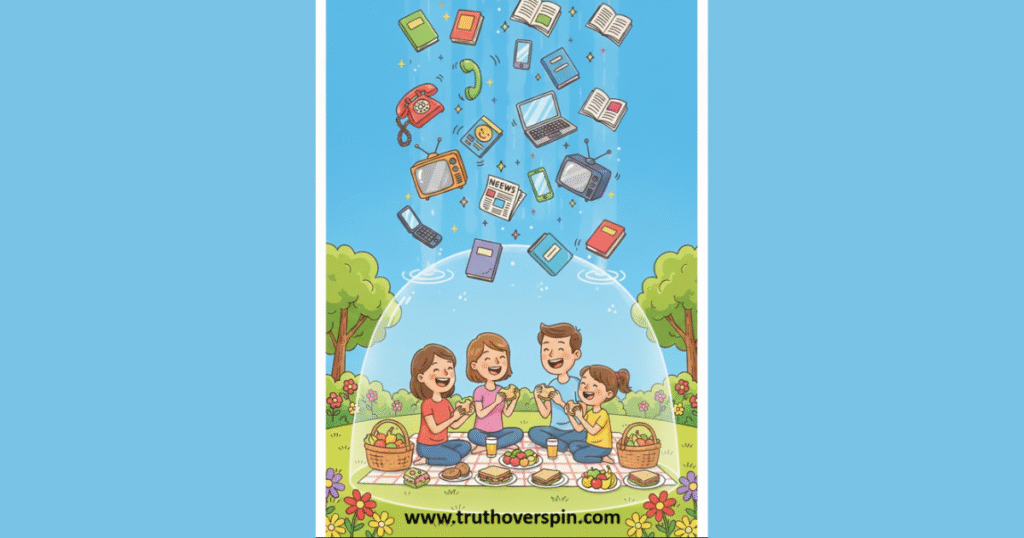
To see the full picture, it helps to remember that humans are not built for isolation. Our ancestors depended on cooperation for basic survival. Working together was not optional; it was the only way communities could provide food, safety, and meaning. Even our physiology reflects this truth: humans regulate stress through eye contact, shared meals, predictable routines, and calm, embodied presence.
When those relational supports weaken, social resilience weakens with them. A divided society is a fragile society, not because of ideology, but because people can no longer rely on one another in the ways human beings always have.
Staying Human in a High-Speed World
McLuhan believed that recognizing the environment we live in is the first step toward staying grounded within it. Awareness matters, but action matters too, especially the kind of action that strengthens connection rather than further fragmenting it.
Human beings stay steady through practices that are simple, old, and biologically effective:
- unhurried conversation
- shared meals and shared spaces
- time outdoors, away from screens
- communities that include a mix of perspectives
- slower rhythms that let the nervous system reset
- consistent, face-to-face relationships that build trust
These habits are neither nostalgic nor sentimental; they are practical safeguards against living in a world that moves too quickly for biology to manage alone. They allow us to rebuild the sense of belonging that once protected entire communities from collapse.
McLuhan often said the key was learning to see the pattern of the present moment. Today, the second key is learning to see one another again—clearly, calmly, and without the filters that technology so easily adds. Once we do that, the reset loses its ability to reshape us completely, because the strength of human connection remains stronger than the speed of the systems around us.
About the Authors
Pam Killeen is a health coach, podcaster, and co-author of The Great Bird Flu Hoax. You can find her on Substack, Facebook, Instagram, LinkedIn, and X, or visit her website at www.truthoverspin.com.
Nelson S. Thall is the former President of the Marshall McLuhan Centre on Global Communications in Toronto, Ontario, and a media scientist and former archivist for renowned media theorist Marshall McLuhan. You can connect with him at nsthall@mcluhanesquetactics.com.